Search This Blog

Showing posts with label android. Show all posts

March 13, 2013

BlackBerry is being sold

As I mentioned several times last year the only remaining option for BlackBerry to return to shareholders at least something is to find a buyer. BlackBerry did not needed to wait for release of BlackBerry 10 as the only items that have remaining value to a buyer are global messaging network and patent portfolio (rated as #5).
However we are still in BlackBerry 10 honeymoon, which will soon meet rough reality: mobile landscape cannot sustain 4th ecosystem. Palm and Symbian went through that stage already.

There is a buyer: Lenovo. PC manufactures wants to move from declining desktop and laptop market to growing tablet and phone. HP tried same move by acquiring Palm. It had disastrous ending. Product was pulled off the market just few days after launch.
If Lenovo is looking to buy BlackBerry for its operating system the ending will be the same. Android and iOS are well entrenched and Microsoft is moving forward as solid 3rd ecosystem. I am not sure what Lenovo can achieve with BlackBerry patent portfolio and global messaging network.
Patent portfolio and global messaging network would be the most valuable to a phone maker looking to differentiate itself.

Perhaps HTC?

June 28, 2012

Nexus 7 and Surface targeting different customer segments

Last few weeks were really exciting for tablet enthusiasts. Microsoft has shocked the world by announcing its Windows 8 tablet hardware branded Surface. Windows OEMs now got the message: make great Windows products or face direct competition. Surface specs are impressive. There are several usability innovations to mention: smart ventilation to prevent overheating (iPad owners know what I am talking about) and of course, keyboard/hard cover. The later adds to the value proposition and can be clearly game changer in the tablet space. Metro UI of the operating system is another substantial addition to the value proposition. Such differentiations make Microsoft Surface target segment more affluent, direct iPad competitor.


The only news worth mentioning about Nexus 7 is price of $199, however there are comparable cheaper devices on the market today. Yes, you can buy Android tablet for less than Android phone! The device is targeting low end user and is in no direct competition with iPad, the dominant tablet device. On the opposite, it competes with other Android makers.
By introducing another low price device Google continued making the Android OEM ecosystem unsustainable mid-term by putting pressure on hardware margins. Committing to make Android devices is the road to no-profits-land, unless business model includes vertial intergation bennefitting from the economies of scope: Samsung makes own chipsets and screens, the most expensive device components; Amazon sells tons of content through its loss leading Kindle devices; Google sells advertising through its operating system. Very few Android OEMs are vertically integrated and barely profitable.

Google has made the news with Nexus 7 but the impact on its ecosystem is negative. Acquisition of Motorola Mobility puts Google in direct competition with its OEMs. Android nominal growth continues now activating 1 million devices per day. Market share growthhas stopped and there are four mid-term issues impeding it further.

June 8, 2012

Android Growth Stalls


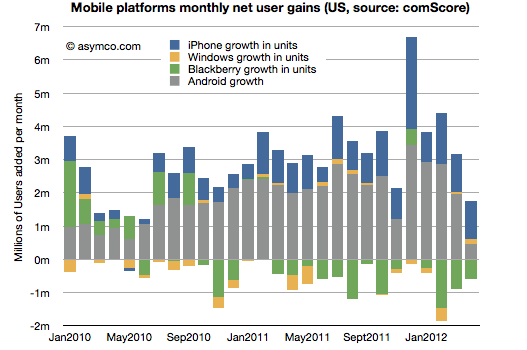
Another prediction that I made is coming true. December 2011 I wrote that Android growth will slow down mid-term. It turns out Android growth is now collapsing. According to data from Asymco showing net adds, last 4 straight months (starting in January) Android adds reduced by 1 or more millions of users.

May 11, 2012

Making money by building apps is becoming difficult

Apps ecosystem health is arguably the most essential piece for mobile platform to be successful and grow. Without installable apps that add value, mobile operating system is just an isolated island from the rest of the information world.
Developers are the key contributors to the ecosystems, many are true enthusiastic altruists, but most aspire to make profit and run a business. If such aspirations are difficult to attain, naturally I would expect number of developers writing apps for the platform to decrease.

I have written before about lack of developers financial successon Android platform and slightly higher earners from Amazon app store. iOS developers comparably make more money from selling their apps as iOS customer is more affluent and more likely to spend money on an app purchase. Naturally this draws developers to develop on the iOS which has led to more that 600k apps but Google Play (formerly Android Market) has almost as many apps.

App developers expectations are high, however, many are disappointed according to a recent apppromo survey: 

·         59% of apps do not generate enough revenue to break even on dev costs
·         80% don’t make enough revenue to sustain a business <<NetNewsWire dev Brent Simmons suspects the figure is "more like 85 percent," while Lucius Kwok believes it may "fall in the range of 90 percent or higher.">>
·         12% earn $50k or more

I interpret those numbers as there are too many apps for new entrants to have success and standout from the incumbent, discoverability continues to be a problem. Revenue distribution among the developers is uneven. Marketing budget for new entrants are small. Several are making astronomical proceeds from the app sales, but 4/5 cannot sustain a business.

May 7, 2012

Amazon Kindle Fire cools off?

When Kindle File went on sale about 6 months ago devices shipped totaled 4.8 million in Q4 of 2011. Analysts estimated strong sales numbers on par with Apple iPad which was also selling about 1 million devices per week and about 15 million total.

Now, number of online articles report that Kindle Fire fell off the cliff. Research firm IDC reports Amazon's share plummeted from about 17% in the fourth quarter of last year to just 4% in this year's opening quarter. IDC’s Tom Mainelli points to targeting and positioning difference of the two tablet products as a reason: "Apple's move to position the iPad as an all-purpose tablet, instead of just a content consumption device, is resonating with consumers as well as educational and commercial buyers." Bloomberg reports “Fatigue is starting to kick in about six months after a product has launched.” Apple sold 24% less iPads in the Q1, but somehow managed to increase market share to 68% from 55%.
However, this may be misleading. The main question to ask is how market share is defined here? IDC measures market share as devices gets shipped, not sold. I assume that Amazon shipped close to 5 million devices in Q4 for the holiday season and some did not sell and as demand seasonally weakened, resulting in Amazon shipping fewer devices for Q1. I assume that some devices shipped in Q4 were sold in Q1. Amazon has yet to disclose any numbers on Kindle sales. There is a definite seasonal effect in sales and shipments of the tablet devices but I have strong reasons to assume Kindle sales did not collapse as shipments indicate. If you look at comScore report showing global digital device usage (not shipments or sales), Kindle Fire commands more than half (54.4%) of Android tablet market, which trumps runner up Samsung Galaxy by more than 3 times.
How sales of Kindle Fire can further increase? There are 4 basic strategies:

1.       Increase promotion: advertising and incentives
2.       Increase channels
3.       Increase volume at the time of purchase
4.       Manage seasonal inventory 

Amazon usually does not have substantial marketing budgets and uses price as main incentive to stimulate sales. On the number two, news such as Target and some other retailers will stop selling Kindles may mean weaker devices sales. In addition, Kindle Fire today is US domestic product leaving international markets untapped. Taking Kindle Fire to the markets outside the USA can provide strong competitive response and boost sales. On the number 3 promoting a family purchase plan may increase sales. Finally, the holiday season is one of the best times to take advantage of opportunistic shoppers buying gifts.

April 20, 2012

60% of new Windows Phone buyers are former iPhone and Android users

I have written previously that based on the trend setup by t-mobile's Lumia 710 sales the most likely buyers of Windows Phone will be segment new to smart phones, former feature phone owners.

However, recent poll shows that only 15% of buyers are former feature phones owners. Most of the new buyers of Windows Phone are past iPhone and Android users, 30% each. People are leaving iPhone and Android for Windows phone

March 27, 2012

Google late paying Android devs for app sales

I have written before that Android developers have started leaving the platform because of high maintenance costs and low revenues. Google is helping the trend. During March 2012 number of Android apps developers reported several weeks delays in payments. They also expressed concerns that Google is impossible to reach and get response when such event happens.

March 23, 2012

Is Windows Phone really going to outsell iPhone in China?

With huge fanfare, coverage in media and blogs Microsoft has officially launched Windows Phone in People’s Republic of China market. Windows Phone ‘Mango’ update was localized in Chinese language and earlier in 2012 Microsoft has launched Windows Phone Marketplace in Chinese. Windows Phone even comes with localized features. Windows Phone People hub instead of Facebook and Twitter integration (blocked in China social networks) connects users to Sina Weibo (Twitter knockoff) and Renren (Facebook adaptation). But it was moot point having no Windows Phone devices on the Chinese market until this week. Today list of OEMs is impressive: HTC, ZTE and Samsung. Arguable the most important of all, Nokia also will be selling Lumia end of March.

Windows Phones are priced rather aggressively around 1000 yuan, which about $150. iPhones are sold at prices at least 5 times higher. Price should definitely help gaining market share. In fact, Bloomberg article reports that Simon Leung, Microsoft China boss, expects Windows Phone to eclipse iPhone and Android in market share, but did not give specific timeline.

Is it reasonable to expect Windows Phone sales to be higher than iPhone after all you read is how people mug each other in front of Apple stores to buy an iPhone in China and how scalpers are making quick bucks brining devices from other countries?

Nicole Peng from Canalys expects Windows Phone to have 6% market share year 2012, and about 12% in 2013. According to Strategy Analytics today Android enjoys 65% market share in China and iPhone is at 13%. Symbian market share was around 18% in 2011 expected to shrink to 12% in 2012. In China today Apple is third in market share behind Symbian. Windows Phone should be taking share from Symbian, considering Nokia is sunsetting Symbian and investing heavily in Windows Phone. Also, I expect Windows Phone to start taking share from Android. Strategy Analytics expects Android to lose 2% share and iPhone to gain 1% each of the next 5 years. However next 5 years Strategy Analytics does not expect Windows Phone to catch iPhone’s market share.

I think it is reasonable to expect Windows Phone to retake most of today’s 18% Symbian market share next two years and take 2% from Android each year as well. In such case Windows Phone market share can be between 14%-18%, which is well in the striking distance of eclipsing iPhone.

March 13, 2012

Developers start leaving Android

Just a few days ago I wrote that 1/4 of developers to not make any revenue on Android ecosystem. For some developers if you factor in costs of development, support and bugs fixes for the fragmented OS it makes little sense to be there.
Mika Mobile, popular game app developer had enough. "From a purely economic perspective, I can no longer legitimize spending time on Android apps, and the new features of the market do nothing to change this." No wonder, "Android sales amounted to around 5% of our revenue for the year, and continues to shrink" while spending 20% of man hours on "porting, platform specific bug fixes, customer service, etc".

Android ecosystem is full of holes that are getting bigger and bigger, as I wrote previously, and it will only will get worse if issues are not addressed. Just renaming of Android Market into Play won't do it.

March 9, 2012

25% developers do not make money on Android

Reading Strategy Analytics report on App Ecosystem by Josh Martin published January 2012 I found on the Exhibit 7 about quarter of developers with apps on Android do not generate any revenue, more than on any other platform. Nokia Ovi is next with 15%. On the other hand, Windows Phone and Blackberry apps developers all reported making money.
My conclusion, if you are developer and want to make money on apps - avoid Android.

February 24, 2012

Developers make more money on Amazon Appstore than on Android Market

For quite some time developers knew that iPhone user is more likely to pay for an app and they can enjoy higher revenues publishing with Apple. There are more free apps on Android Market and average price also lower than on iPhone app store.

Kindle Fire case is rather interesting. Expectations of success of a branched store should be low. A recent article reported that Amazon Appstore, which has selected apps from Android Market as well as Amazon-only, have their developers enjoy higher revenues than Android. In addition Amazon Appstore customers are more likely to buy an app than Android customers. Same article reports that over 60% of Amazon Appstore apps are paid compared to less than 35% on Android Market.

I am not surprised. Amazon customer are buyers – go to Amazon to make purchases. Google evolves around concept of free.

January 27, 2012

Android market share declines by 5%

It did not take more than a month before my prediction of Android demise came true. ABIresearch reported that global share of Android devices shipped has declined "from its 3Q high of 52.5% to 47.0% in Q4".
Apple for the first time sold more iPhones (37 million) than any other Android OEM.

Is this the beginning of Android decline. Not yet, in my opinion. Not until Windows Phone and Nokia partnership start seeing bigger market share gains.

January 19, 2012

One-trick pony no more: mobile revenue becomes major contributor for Google

Google Android mobile OS is free to license for any OEM who makes phones or tablet computers. Google's business model is to monetize its mobile operating system through advertising:
  • Android Market takes percentage of paid apps sales
  • AdMob - advertising platform - provides ads for mobile apps and mobile websites
  • In addition, AdSense is is optimized for mobile websites
  • Google web search advertising is mobile optimized
Google mobile business has reached $1 billion in 2010 and reached $2.5 in 2011. Piper Jaffray estimates the revenue to exceed $4 billion in 2012. I think the trend of 150% anual revenue growth is most likely to continue in year 2012 considering competition is catching up.
Post 2012 Android ecosystem will start expriening growth problems due to

January 17, 2012

Samsung Responds to Google buying Motorola Mobility

Financial Times reported that Samsung is going to work with Intel to extend proprietary Bada operating system to run on Intel chips. Intel has long wanted to compete in the mobile chips space finding itself behind competition. Intel partnership with Nokia on Meego operating system is doomed and new partnership with Samsung, one of the biggest phone makers, makes sense for Intel.

Samsung, on the other hand, privately (along with HTC) expressed concerns about Google buying Motorola Mobility and its further dependency on Android. Google becoming phone maker will directly compete with OEMs who produce phones with Android OS. Also, Android OS is no longer free (patents royalties) and not as opened. Samsung is trying to advance further own mobile operating system (Bada) to reduce the risk of depending too much on Android. There are also Samsung phones with Windows Phone operating system that will reduce dependency on Android further. Today Bada and Windows Phone have about the same global market share: 2%

January 6, 2012

While Android phones dominate market web browsing happens on iOS

NetMarketshare published report showing consistently around 50% of mobile web traffic coming from iOS (iPhone and iPad), while Android is in high teens.

December 23, 2011

What Mobile Phone People Want for Chrismass?

Apple and Google dominate the smartphone sales while Blackberry slowly fading into irrelevancy. What people what for Christmas? Mobile phones are high on the list. Amazon's 5 of 10 top rated phones are Windows Phones, including first Top 3. Not Android.


December 21, 2011

Mid-term viability of Android ecosystem

Android market share is eclipsing all competitors increasing from 2% two years ago to over 50%. Android Market has over 500k apps. Andy Rubin twitted this month that about 800k Android devices are activated every day. Android has been a billion+ dollar business for Google for 1.5 years. The business is good, right? While the short term gains are very impressive there are 4 fundamental problems with Android ecosystem which raises questions about its future.

·        Patents and insufficient of intellectual property portfolio. The main Android value proposition to OEMs was free license. Now increasingly OEMs, such as HTC and Samsung, are paying patent royalties to Microsoft higher than licensing fees for Windows Phone. OEMs also pay royalties to Apple and in selected markets was banned. Most recently courts ruled in favor of Microsoft against Motorola Mobility which is being acquired by Google. Android is no longer free. To maintain margins at the same level OEMs will have to cut cost at the expense of hardware, which will diminish user experience. OEMs will no longer have incentive to favor Android when Windows Phone is a viable option.

·         Fragmentation. Second biggest value proposition was Android openness. Anybody can take the source code and change it to fit their needs. Leading OEMs, such as Samsung, HTC and Motorola have blended their brands and color schemes into Android devices. They also have changed source code making apps not compatible across different devices. It frustrates developers and users. Google has tried to control that to some extent which received cold reaction from the ecosystem stakeholders.

·         Security. Android Market has no barriers of entry for malicious software makers. Scammers can have an app published within minutes and Google does not verify if the app is legitimate or even works. Google has been very proactive removing malware postpartum, which is often too late - damage is done. Competitors, such as Microsoft are using it to lure away the Android users burned by scam artists. Sooner rather than later Google will face "Toyota problem", when strong brand known for quality was hit by nemerous safety defects losing it's global leadership in car sales as a result.

·         Slower market share growth. When a product has a lion share of the market (Android commands over 50%) the remaining half is much harder and takes longer to acquire. When you reach the bell curve the market segment is very different and requires different approach.

November 27, 2011

Android security concerns start to draw attention

Back in May 2011 I wrote a short blog article that disregard for security by Google Android will effect its growth. It yet has to happen. Android continues to gobble up market share, why care? Today not only Android system is an easy target, Android Market has virtually no verification process of what is published there. Yes, Google removes malware upon complaints promptly, but as one article says "I don't think people realize how chaotic this ecosystem is".

Google should take better care of own customers, not only because it is decent and should not 'do evil', but also because screwing own users is bad for business. Ask Netflix CEO. Better example is Toyota. Toyota's market share was the largest in the world until customers discovered it was lethally dangerous. The same article writes: "majority of users are simply unaware of Android security flaws because they haven't been caught in an attack". Wait a little. Android malware has jumped 472 percent in the four months since July 2011.

November 24, 2011

Adobe gives up on mobile, clears way for HTML5

Steve Jobs hated Flash for his own reasons, one of those was performance. iOS does not support Flash. Android platform supporting Flash used it to differentiate. No more. Ice cream sandwich (Android 4.0) will be the last OS with Flash. It is interesting that Adobe initiates the breakup and announces "HTML5 the best solution for creating and deploying content in the browser across mobile platforms.”
This hopyfully will speed adoption of HTML5 which will be good for consumers and developer community.

October 31, 2011

Mobile apps downloads to hit new high: 30 billion in 2011

Depending what you read projected apps downloads will be around 30 billion end of year 2011. previous year the apps downloads accounted to 9 billion across all mobile platforms. Mobile apps and the scale offers lucrative business for mobile apps developers. Apple iPhone users are more likely to pay for the app and downloads per user are twice as high as Android. Both apps stores have over 350k apps, with Windows Phone distant second with over 30k.